
Engineering Executive Summary: While large overhead bridge cranes handle long-bay macro transport, industrial jib cranes provide dedicated, high-frequency micro-lifting (0.25t to 16t) directly over individual workstations, CNC machining centers, and assembly cells. Selecting the proper jib configuration requires evaluating three primary mechanical factors: mounting architecture (freestanding pillar vs. wall-bracket cantilever), rotational slewing arc (180°, 270°, or continuous 360°), and foundation overturning moment ($M_{overturn}$). This guide breaks down structural sizing, concrete foundation calculations, and hoist pairing according to ISO 4301 and CMAA 74 standards.
1. Introduction: Eliminating Overhead Crane Bottlenecks
In busy manufacturing environments, skilled CNC machinists, welders, and press operators frequently lose 15 to 30 minutes per shift waiting for the main plant overhead bridge crane to become available just to load a 500 kg raw forging or unload a finished component.
Deploying dedicated industrial jib cranes over key workstations creates an independent lifting cell. The operator controls their own loading cycle instantly, freeing up the primary bridge crane for heavy inter-bay transport and dramatically increasing overall factory throughput.
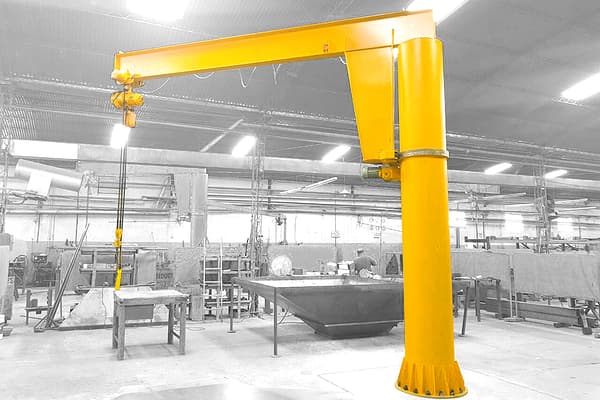
Figure 1: Heavy-duty freestanding pillar-mounted jib crane providing 360-degree rotational coverage over twin machining centers.
2. Comprehensive Comparison: The 4 Primary Jib Crane Architectures
Jib cranes are engineered in four primary structural configurations, each suited to specific building geometry and workspace constraints:
| Jib Crane Configuration | Rotation Angle | Capacity & Boom Span | Structural Mounting Requirements |
|---|---|---|---|
| Freestanding Pillar Jib (BZ Type) | 360° Continuous Rotation | 0.5t – 16 tons • Span up to 12m | Requires dedicated reinforced concrete foundation pad & high-tensile anchor bolts |
| Wall-Mounted Cantilever (BX Type) | 180° – 200° Semicircular Arc | 0.25t – 5 tons • Span up to 8m | Bolts directly to existing reinforced concrete building columns or steel uprights; zero floor footprint |
| Wall-Traveling Jib Crane (BB Type) | Fixed boom (Linear Travel) | 0.5t – 5 tons • Span 3m – 7m | Operates on multi-tier wall-mounted runway rails mounted below the main overhead crane |
| Articulating Knuckle Boom Jib | 360° Inner + 360° Outer Arm | 125 kg – 2 tons • Radius up to 6m | Pillar or wall-mounted; dual pivot joints reach around building pillars and into machine enclosures |

Figure 2: Wall-bracket cantilever jib crane saving 100% of factory floor space by mounting directly to structural building columns.
3. Overturning Moment ($M$) & Foundation Sizing Calculations
For freestanding pillar jib cranes, the most critical engineering check is verifying the overturning moment ($M$) transmitted to the concrete foundation. Because the load acts at the end of a long cantilever arm, it generates immense bending stress at the baseplate connection.
Overturning Moment Formula:
M = φ × (Q + Ghoist) × R + Gboom × (R / 2)
- M: Total overturning moment at column base (kN·m).
- Q: Rated lifting load capacity (kN).
- Ghoist: Dead weight of the electric hoist trolley (kN).
- R: Working radius (reach from column centerline to outer hook limit, m).
- Gboom: Dead weight of the horizontal cantilever $I$-beam or box arm (kN).
- φ: Dynamic impact factor (typically 1.25 per CMAA 74 / ISO 4301).
Foundation Design Options:
- Square/Hexagonal Concrete Footing: The standard approach for heavy jibs (≥ 3t). Excavate a dedicated reinforced concrete foundation pad (typically $2\text{m} \times 2\text{m} \times 1.2\text{m}$ to $3.5\text{m} \times 3.5\text{m} \times 1.8\text{m}$) containing high-strength J-bolt anchor cages.
- Sleeve-Insert Embedded Foundation: A heavy steel sleeve is cast directly into the concrete foundation. The mast is dropped into the sleeve and grouted, offering maximum rigidity for long spans.
- Existing Floor Slab Mount (≤ 1 ton only): Only permissible if the concrete floor slab is at least 150mm–200mm thick reinforced 30 MPa concrete, using chemical epoxy anchor studs.

Figure 3: Heavy pillar jib crane equipped with an electric chain hoist and motorized slewing gearbox.
4. Manual Slewing vs. Motorized Slewing Drives
Depending on the load capacity and boom reach, rotation can be actuated manually or with an electric slewing reducer:
- Manual Rotation (Push-Pull): Recommended for capacities ≤ 2 tons and arm lengths ≤ 5 meters. The operator simply guides the load by hand. Precision tapered roller bearings in the pivot assembly ensure a minimal rotational effort (≤ 15 kg push force).
- Motorized Electric Slewing: Essential for capacities ≥ 3 tons, arm lengths > 6 meters, or applications with high wind drag. Driven by a cycloidal or planetary gear motor with internal soft-start variable frequency drive (VFD) to prevent rotational load swinging.
- Continuous 360° Slip-Ring Collector: For continuous motorized rotation, an internal electrical slip-ring collector inside the pillar column prevents power cables from twisting during uninterrupted multi-turn operations.
5. Articulating (Knuckle Boom) Jib Cranes for Complex Workspaces
Standard straight-arm jibs are limited by straight-line clearance. In tight machine shops with overhead ducts, building columns, or open CNC machine doors, an articulating knuckle boom jib crane provides unmatched flexibility.

Figure 4: Heavy-duty articulating knuckle boom jib crane engineered for complex radial reach in marine and industrial environments.
- Dual Pivot Joints: Two independent arms rotate 360° at the mast and 360° at the elbow joint.
- Reaching Around Obstacles: Enables the operator to guide the hook into machine enclosures, under mezzanines, and around building structural columns with zero dead zones.
6. Hoist Selection for Jib Cranes: Chain vs. Wire Rope
For 90% of jib crane applications, an electric chain hoist is superior to a wire rope hoist:
- True Vertical Lift: Chain hoists lift straight up without the slight horizontal hook drift inherent to single-drum wire rope spooling.
- Compact Headroom & Light Weight: Less dead weight reduces the overturning moment on the cantilever boom.
- Dual Speed Staging: Fast speed for rapid transit; micro-creep speed (1/6 ratio) for precision die positioning and mold alignment.
- For specialized heavy jibs (≥ 5t to 16t), pair with a low-headroom European wire rope hoist.
7. Why Global Manufacturing Plants Choose KCICRANES Jib Solutions
Located in Xinxiang, Henan—the lifting machinery heartland of China—KCICRANES engineers custom freestanding, wall-mounted, and articulating jib cranes certified to ISO 9001 and CE directives:
- Heavy Seamless Steel Pipe Columns: Thick-walled Q355B structural steel tubing provides superior torsional stiffness and minimal boom tip deflection ($L/350$).
- Precision Machined Pivot Journals: CNC-turned pivot shafts with heavy-duty spherical roller thrust bearings ensure smooth, whisper-quiet rotation.
- Full Turnkey Anchor Packages: Every freestanding crane ships with complete anchor bolt template cages, foundation structural calculation sheets, and torque specs for rapid installation.
- Complete Crane Kits Available: Combine with KCICRANES crane kits, festoon power tracks, and forged wheels.
8. Frequently Asked Questions (FAQ)
Q1: Can I install a pillar jib crane directly onto my existing concrete floor?
A: For small jibs (≤ 1 ton with boom span ≤ 3.5m), installation on an existing 150mm–200mm reinforced concrete slab is possible using chemical anchor studs. For capacities ≥ 2 tons or spans > 4m, a dedicated reinforced concrete foundation pad is mandatory to resist the calculated overturning moment.
Q2: What is the maximum practical capacity and span for a freestanding jib crane?
A: Standard freestanding jib cranes are built up to 16 tons with spans up to 12 meters. Beyond 16 tons or 12m spans, a semi-gantry crane or single-girder bridge crane is generally more structurally economical.
Q3: How do wall-mounted jib cranes attach to building columns?
A: Wall-bracket jibs attach to steel columns via clamp-on wrap-around tie plates or direct high-strength bolting. For concrete building columns, they attach via heavy-duty through-bolts with backer plates on the reverse side of the column.
Configure Your Workstation Jib Crane with KCICRANES
Send us your required capacity, boom reach, available building height, and mounting preferences. Our lifting engineers will provide complete CAD drawings, foundation calculation sheets, and factory-direct pricing within 24 hours.