
Executive Summary: The wire rope drum is the central mechanical component in any crane hoisting mechanism. Ensuring safe load handling requires precise calculation of the drum diameter ratio ($D/d \ge 16 \sim 30$), helical groove radius ($r \approx 0.53d$), pitch, and fleet angle (≤ 4°). Below is a practical guide covering design formulas, material grades, groove wear replacement limits, and maintenance practices according to ISO 4301, DIN 15020, and FEM standards.
1. Introduction: Why Drum Design Determines Hoisting Lifespan
In industrial lifting systems—from standard single-girder shop cranes to 100-ton foundry overhead cranes—the wire rope drum bears the full dynamic tension generated during load elevation. A well-designed drum does more than merely store steel cable; it guarantees uniform rope spooling, minimizes inter-strand friction, prevents rope crushing, and maintains smooth torque transmission from the reduction gearbox.
Premature wire rope fatigue, uneven spooling, and accelerated groove wear account for nearly 40% of overhead crane hoisting downtime. Understanding drum geometry and material selection is vital for maintenance engineers, crane builders, and procurement specialists.

Figure 1: Precision CNC-machined helical groove wire rope drum for industrial hoisting mechanisms.
2. Fundamental Drum Sizing Calculations ($D/d$ Ratio)
The most critical parameter in drum engineering is the ratio between the drum pitch diameter ($D$) and the nominal wire rope diameter ($d$). Bending a wire rope around too small a radius induces severe localized bending stress, rapidly fatiguing outer wires and dramatically shortening rope life.
Core Design Formula:
D ≥ e1 × e2 × d
- D: Pitch diameter of the drum (measured to the center of the spooled wire rope, mm).
- d: Nominal diameter of the steel wire rope (mm).
- e1: Coefficient determined by the mechanism working class (ISO 4301 / FEM 9.511 / GB/T 3811).
- e2: Coefficient determined by the rope reeving configuration and drive type.
Standard $D/d$ Ratios by Mechanism Working Class (ISO / FEM)
According to ISO 4301-1 and DIN 15020 standards, minimum $D/d$ coefficients are classified as follows:
| ISO Mechanism Class | FEM 9.511 Equivalent | Typical Duty Condition | Recommended D/d Minimum |
|---|---|---|---|
| M3 / M4 | 1Am / 2m | Light assembly workshops, maintenance | 16 : 1 – 18 : 1 |
| M5 / M6 | 3m / 4m | General manufacturing, machine shops, logistics | 20 : 1 – 22.4 : 1 |
| M7 / M8 | 5m | Steel mills, continuous batch casting, container handling | 25 : 1 – 30 : 1 |
3. Helical Groove Geometry and Dimensioning
Modern crane kits and hoisting components employ CNC-turned helical grooves to guide the wire rope neatly along the drum face. Proper groove profiling prevents excessive contact pressure on individual outer wires and eliminates side-scuffing.
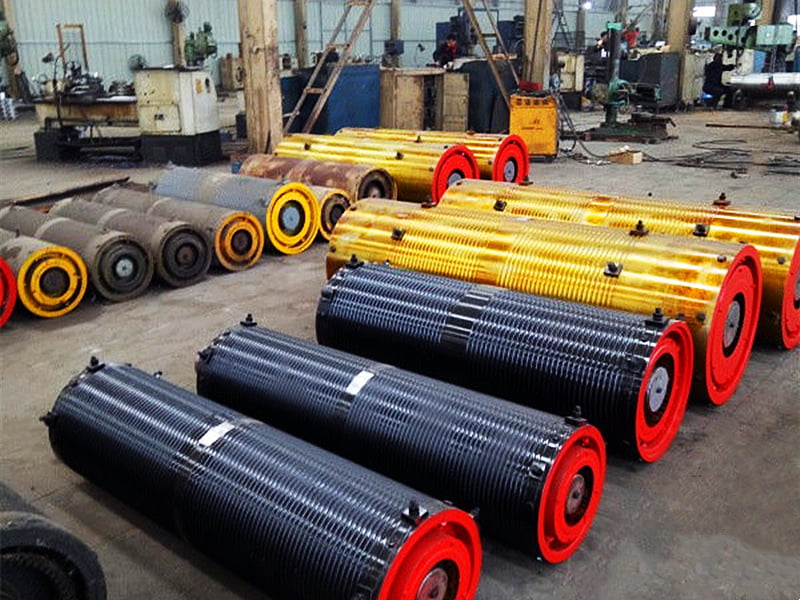
Figure 2: Multi-drum fabrication in KCICRANES workshop showing double helical groove turning.
Key Groove Dimensions
- Groove Radius ($r$): Standard recommendation is $r = (0.525 \sim 0.54) \times d$, with $r = 0.53d$ being the industrial optimum. If $r$ is too tight ($< 0.52d$), the rope gets pinched; if too loose ($> 0.56d$), the contact surface area drops, concentrating pressure.
- Groove Pitch ($p$): The center-to-center distance between adjacent grooves. For single-layer winding, $p \approx d + (1.5 \sim 3\text{ mm})$ depending on rope diameter.
- Groove Depth ($h$): Typically $h = (0.33 \sim 0.40) \times d$.
- Fleet Angle Limit: The angle between the rope entering the groove and the drum groove centerline must not exceed 4° for smooth drums and ≤ 3° (ideally ≤ 1.5°) for grooved drums to prevent the rope from climbing out of the groove.
4. Material Selection: Cast Iron, Cast Steel, vs. Seamless Steel Pipe
The choice of drum material directly affects shock resistance, weight, and fabrication cost. At KCICRANES, we select raw materials tailored to specific lifting duty cycles:
| Material Type | Standard Grades | Key Advantages | Best Suited Applications |
|---|---|---|---|
| Grey Cast Iron | HT200 / HT250 (GG20 / GG25) | Self-lubricating graphite structure, high damping capacity, cost-effective | Standard light-to-medium duty wire rope hoists (M3–M5, ≤ 16 tons) |
| Cast Steel | ZG270-500 / ZG310-570 (GS-52) | High tensile strength, impact toughness under severe shock loads | Heavy industrial cranes (20t–100t+), metallurgy, marine grab winches |
| Fabricated Seamless Steel Pipe | Q355B / Q345B / 42CrMo Tube | Zero casting defects, lightweight, high concentricity, customizable length | European-style electric hoists, high lift heights, export equipment |
5. Drum Groove Wear Limits and Inspection Criteria
Periodic inspection of drum grooves is essential to prevent rope snagging and sudden load slips. According to ISO 4309 and crane maintenance safety standards, replace or re-machine the drum if you observe any of the following:
Mandatory Replacement & Repair Criteria:
- Wall Thickness Wear: When localized groove wear reduces the drum barrel wall thickness by 10% to 15% of its original design thickness.
- Groove Contour Deformation: When the bottom radius has worn flat or developed sharp ridges/burrs that score the wire rope outer strands.
- Surface Cracking: Any radial or longitudinal cracks detected via Non-Destructive Testing (NDT / Magnetic Particle Testing). Welding repair is strictly prohibited on cast iron drums.
- Rope Dead Wraps: When the hook is at its lowest operating position, a minimum of 2 to 3 safety dead wraps must remain securely anchored on the drum.
6. Why Global Crane Builders Choose KCICRANES Drums
As a specialized lifting equipment and crane kit manufacturer located in Xinxiang, Henan (the crane manufacturing hub of China), KCICRANES manufactures complete hoisting systems and precision replacement components:
- Full CNC Groove Turning: Guaranteed pitch uniformity and smooth radius transition ($Ra \le 3.2\mu m$).
- Strict NDT Inspection: 100% ultrasonic and magnetic particle testing on cast and welded barrels.
- Dynamic Balancing: Precision dynamic balancing at rated hoisting speed to eliminate high-speed vibration.
- Custom Shaft & Coupling Integration: Built with internal gear couplings, splined hubs, or integral flanged drives for seamless retrofit on European and traditional hoisting systems.

Figure 3: Heavy duty drum barrel assembly prepared for global sea freight shipment.
7. Frequently Asked Questions (FAQ)
Q1: What is the recommended safety dead wrap count on a crane drum?
A: Standard safety codes (OSHA, EN 13001, ISO 4301) mandate that at least 2 full wraps (preferably 3) of wire rope remain on the drum when the hook is in its lowest working position. This prevents direct load stress on the rope clamping plate.
Q2: Can worn drum grooves be re-machined?
A: Yes, provided that the remaining wall thickness after re-machining still meets the minimum calculated structural safety factor (typically leaving > 85% of original wall thickness) and the material has no structural fatigue cracks.
Q3: How do I select between a Cast Steel drum and a Fabricated Pipe drum?
A: For heavy-duty metallurgy and foundry cranes (M7/M8, 30t–100t+), Cast Steel (ZG270-500) offers superior shock resistance. For modern European-type low-headroom hoists and fast-turnaround custom replacements, seamless steel pipe (Q355B / 42CrMo) provides lighter weight, zero casting porosity, and rapid precision machining.
Need Custom Crane Drum Engineering or Replacement Kits?
KCICRANES provides tailored wire rope drum design, precision machining, and worldwide delivery for overhead cranes, gantry cranes, and winches.