
Engineering Executive Summary: Unlike indoor bridge cranes that rely on building columns, industrial gantry cranes (portal or Goliath cranes) are self-supporting lifting structures that operate on ground-level rails or heavy-duty rubber tires. Selecting the optimal gantry crane requires balancing four interconnected engineering parameters: structural beam profile (welded box vs. open truss), girder configuration (single vs. double beam), cantilever overhang length, and outdoor wind-load anchoring. This technical guide outlines the structural selection criteria, rail foundation sizing, and safety calculations to ensure maximum operational uptime and structural integrity.
1. Introduction: When and Why to Deploy a Gantry Crane
For outdoor stockyards, precast concrete yards, shipyards, railway freight terminals, and unreinforced manufacturing workshops, erecting a standalone steel building solely to support an overhead crane runway is often cost-prohibitive. A gantry crane eliminates the need for expensive vertical building columns by incorporating its own rigid legs and end carriages directly over ground runway tracks.
However, outdoor gantry engineering introduces distinct structural challenges rarely encountered indoors: extreme wind cross-forces, thermal expansion over long rail spans, rail misalignment due to ground settling, and horizontal skewing during high-speed travel. Proper upfront specification is critical.

Figure 1: Heavy-duty MG-type double girder gantry crane (Goliath crane) handling bulk materials with twin cantilevers in an outdoor terminal.
2. Box Girder vs. Truss Girder: The Aerodynamic & Structural Trade-off
The most prominent design decision for outdoor gantry cranes is selecting between a solid-web welded box girder and an open lattice truss girder.
| Engineering Feature | Box Girder Design (Standard Welded Box) | Truss Girder Design (Open Lattice Framework) |
|---|---|---|
| Aerodynamic Wind Resistance | High wind drag coefficient ($C_w \\approx 1.2 \\sim 1.6$) → requires heavier anchor clamps | Extremely low wind resistance ($C_w \\approx 0.4 \\sim 0.6$) → ideal for coastal and high-wind zones |
| Torsional Rigidity & Deflection | Maximum torsional stiffness ($L/800 \\sim L/1000$); smooth high-speed travel | Moderate stiffness; higher horizontal deflection under rapid braking |
| Dead Weight of Crane | Heavier dead weight → higher wheel pressure ($P_{max}$) | 15% to 30% lighter dead weight → reduced ground foundation costs |
| Corrosion Protection & Painting | Smooth planar plates; easy to shot-blast, epoxy coat, and maintain | Hundreds of tubular welded joints; difficult to repaint in humid/marine environments |
| Best Operational Environments | Indoor factories, sheltered precast yards, ports with wind barriers (≤ 15 m/s) | Coastal ports, high-altitude open plains, windy desert logistics yards (> 20 m/s) |

Figure 2: MH-series truss-type single girder gantry crane designed for outdoor precast yards subject to strong seasonal crosswinds.
3. Single Girder vs. Double Girder Gantry Sizing
When to Specify a Single Girder Gantry (MH Type)
A single girder gantry crane features an electric hoist (wire rope hoist or chain hoist) suspended from the lower flange of the main girder.
- Capacity Range: 0.5 to 20 tons (Most common: 3t, 5t, 10t, 16t).
- Span Lengths: Economical from 10m to 26m.
- Key Advantage: Compact structural profile, lower wheel loads, and fast turnaround fabrication.
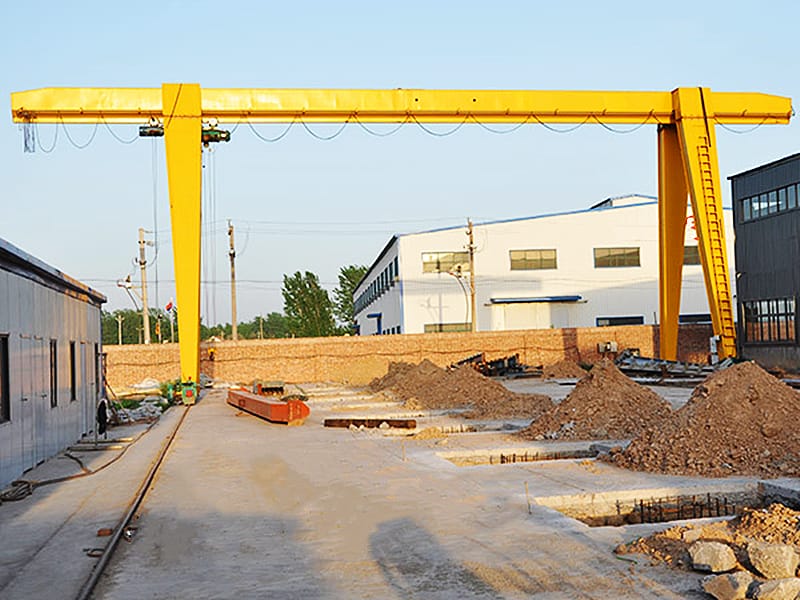
Figure 3: MH-type box single girder gantry crane with European low-headroom hoist in a steel fabrication stockyard.
When to Specify a Double Girder Gantry (MG Type)
A double girder gantry crane utilizes two main girders with a top-running crab trolley traveling along rails mounted to the tops of both beams.
- Capacity Range: 5 tons to 100+ tons (Up to 500t for shipyard Goliath cranes).
- Span Lengths: Easily spans 18m to 40m+.
- A-Type vs. U-Type Leg Profiles: For container terminals and long steel bar handling, U-type legs allow bulky cargo to pass freely through the gantry legs without interference.
4. Cantilever (Overhang) Design: Maximizing Yard Usability
One of the distinct advantages of a gantry crane over an overhead bridge crane is the ability to extend the main girder beyond the runway rails. These extensions are known as cantilevers (outriggers).
Total Span Geometry Calculation:
Ltotal = S + L1 + L2
- S (Rail Gauge / Span): Distance between the centerlines of the two ground runway rails (m).
- L1 / L2 (Cantilever Lengths): Effective overhang extending beyond the runway tracks (typically $L_1, L_2 \\le 0.3 \\times S$).
Operational Value: By extending a 4m to 6m cantilever over an adjacent truck roadway or railway siding, the crane hoist can lift raw steel directly from incoming flatbed trailers outside the rail gauge and transport it into the main storage bay without secondary handling.
5. Portable & Mobile Gantry Cranes (A-Frame Workshop Solutions)
For indoor assembly workshops, maintenance garages, and cleanrooms requiring flexible lifting without fixed floor rails, portable mobile A-frame gantry cranes provide an agile alternative.
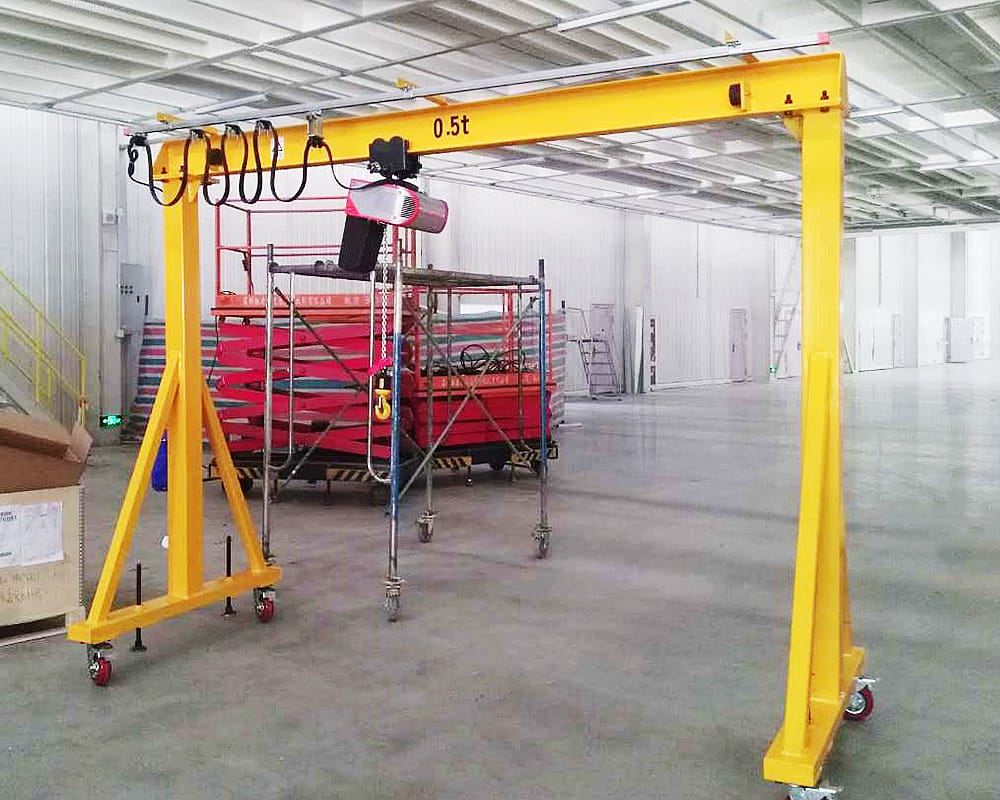
Figure 4: KCICRANES heavy-duty mobile A-frame gantry crane fitted with 360-degree locking polyurethane casters.
- Capacity Range: 250 kg up to 10 tons.
- Mobility: Fitted with heavy-duty 360° swivel polyurethane caster wheels or motorized electric rubber-tyred drives.
- Adjustable Height & Span: Telescoping uprights with manual pin-locking or hydraulic lift cylinders allow operators to clear low doorways and overhead obstructions.
6. Rail & Ground Foundation Engineering: Avoiding Rail Gnawing
A gantry crane is only as reliable as the ground foundation supporting its runway. Because ground rails endure continuous outdoor temperature cycling and heavy dynamic wheel loads, proper track specification is paramount:
Critical Ground Runway Engineering Rules:
- Rail Profile Selection: Match wheel diameter and rated load to standard crane rails: P38 / P43 for light gantry cranes (≤ 10t); QU70 / QU80 / QU100 / QU120 for heavy double girder cranes (16t–100t+).
- Forged 42CrMo Wheels & DRS Blocks: Specify forged crane wheels (42CrMo / 65Mn) with double flanges to prevent derailment and resist flange wear caused by thermal span variance.
- Mandatory Outdoor Safety Hardware: Outdoor gantry cranes MUST be equipped with:
- Automatic Hydraulic Rail Clamps / Storm Brakes: Engage instantly when wind speed sensors exceed safe operating limits (> 20 m/s).
- Rail Sweep Brackets: Clear gravel, debris, and snow directly ahead of travel wheels.
- Polyurethane Energy-Absorbing Buffers: Prevent structural shocks at end-stops.
7. Why International Contractors Rely on KCICRANES Gantry Solutions
As a specialized gantry crane and crane component manufacturer in Xinxiang, Henan, KCICRANES delivers fully certified lifting infrastructure to international buyers across the Middle East, Southeast Asia, South America, and Africa:
- FEM / ISO 4301 / GB Standard Compliance: Complete finite element analysis (FEA) ensures minimal structural deflection under full rated load plus dynamic impact coefficients.
- Modular Segmented Girders: Flanged bolted splices enable full 20m–35m girders to fit inside standard 40ft High Cube (HQ) shipping containers, saving up to 60% on breakbulk ocean freight.
- Heavy-Duty Open Winch Trolleys: For continuous M6–M8 heavy duty cycles, our fabricated open winches offer easy serviceability and superior thermal capacity over enclosed hoists.
8. Frequently Asked Questions (FAQ)
Q1: What foundation is required for an outdoor rail-mounted gantry crane?
A: Rail-mounted gantry cranes require reinforced concrete strip foundations (continuous reinforced grade beams) or concrete ties on compacted ballast, engineered to withstand the calculated maximum wheel load ($P_{max}$) and prevent differential ground settling.
Q2: How do storm brakes and rail clamps work on outdoor gantry cranes?
A: Storm brakes use spring-applied, hydraulic-released clamping jaws that grip both sides of the rail head. If power is cut or an anemometer detects wind speeds exceeding 20 m/s, the clamps lock automatically to prevent the crane from being blown down the tracks.
Q3: Can a gantry crane main girder be shipped in standard sea containers?
A: Yes! KCICRANES engineers precision flanged connections with high-strength Grade 10.9 bolts, allowing 20m to 35m gantry beams to be segmented into 11.8m sub-assemblies that fit neatly inside standard 40ft HQ containers.
Plan Your Gantry Crane Project with KCICRANES Engineers
Send us your required lifting capacity, span, cantilever requirements, and installation site conditions. We will provide full engineering drawings, foundation wheel load data, and a competitive factory-direct proposal within 24 hours.